 So. You’ve heard of Greyfriars Bobby, right? Everyone has. Walt Disney made a sickly sweet film with appalling Scottish accents about it, and there’s been about three zillion books about him.
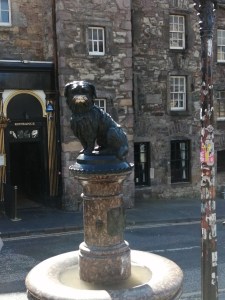
Still not ringing a bell? That’s him on the left, or at least a statue of him. The authorised version of his life story goes something like this (deep breath):
On or around 1858, a Skye terrier accompanied the funeral of his owner to Greyfriars Churchyard in the heart of Edinburgh. Grieving his master, he refused to leave his graveside or be ‘owned’ by anyone else. This brought him into conflict with the civic authorities in 1867, as a licensing system for dogs had been brought in and unlicensed strays were to be caught and destroyed. Fortunately some human friends of Bobby spoke up for him, and eventually the Lord Provost himself intervened, arranging for a special Council dog collar to be made for him.
Bobby was to live on for fourteen years after his master’s death, eventually joining the 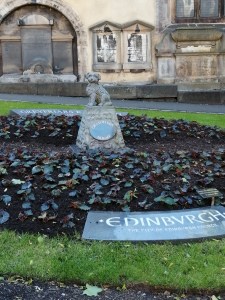 doggy heavenly choir in 1872. By then he had more or less been persuaded indoors to be cared for by one of his benefactors, John Traill, who ran a Temperance Coffee House near the gates of the churchyard. However, Bobby’s death only increased his celebrity. An English noblewoman, Baroness Burdett-Coutts, funded the erection of the statue on top of a drinking fountain that is still the most famous symbol of the faithful hound.
Apart from various newspaper reports – including an obituary in the Scotsman – the first printed account of the sainted mutt’s life was by an American writer, Eleanor Atkinson, in 1912. This filled out a bit of the background of Bobby’s owner – he was apparently a Midlothian shepherd, Auld Jock, who pegged out whilst in Traill’s coffee house and was swiftly planted in the historic churchyard, leading to Bobby’s rather longer residency in the area.
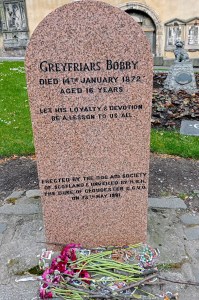
Whoever Bobby’s owner actually was, he now has a gravestone in the Churchyard itself, as does Bobby, who, according to contemporary accounts, was buried on the spot in 1872 in a flowerpot.
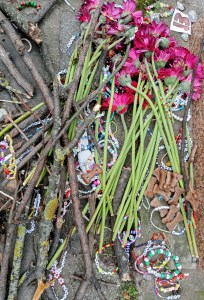
Passing the sacred site the other day to take these photos, there was no shortage of interest in Bobby memorabilia. The most famous, of course, is the drinking fountain statue at the top of Candlemaker Row which, despite being run into by careless motorists at least three times, still stands proudly, its nose rubbed bright and shiny by countless tourist hands (I think they think it brings them luck or something). People were taking selfies with the statue; in the Churchyard itself, flowers had been left, as well as friendship bracelets (that may or may not have been something to do with Taylor Swift’s recent ground-shaking concerts at Murrayfield).
Last but by no means least, should the weary visitor have worked up a healthy thirst with all this dog idolatry, Traill’s Temperance and Coffee House may be long gone, but fortunately right next to the Churchyard gates there’s an excellent hostelry named after the dog which does good food and beverages of the temperate and intemperate kind.
So what? Many of you will have heard the story before, and the above summary and accompanying pictures contribute nothing new. Well, just this: Most, or indeed possibly nearly all of it is untrue!
There was a dog. At least one. Several pretty reliable witnesses have attested on various occasions to the existence of some kind of canine presence in the Churchyard around that 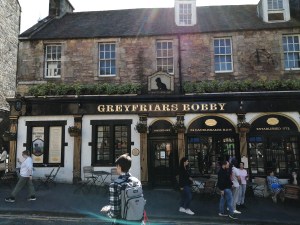 time. But it may not have been a Skye terrier: a 2022 book was widely reported to have shown that it may have been a Dandie Dinmont, a much rarer breed.
So what? You might say again. There was a dog, and he lay on his master’s grave. There’s solid evidence for that, isn’t there?
Well, not as such. The early reports talk about someone being brought in from out of town to be buried, something which Eleanor Atkinson worked up into a story about some aged Midlothian shepherd. The problem with that is, much as today you need an Edinburgh Council pass to travel on the trams for free, back in the 1850s you needed to be an Edinburgh resident to get a slot in the overstuffed accommodation available in Greyfriars. Another candidate for Bobby’s owner, a policeman named Gray, exists nowhere in the city records, at least not as having died at the right time.
Much of this debunking, by the way, is neatly summarised in a 2011 book by Jan Bondeson,
Greyfriars Bobby, the most faithful dog in the world (Amberley Publishing). In a short and amusing book, Bondeson explains how there had always been cynics who thought much of the Bobby legend a confection, from town councillors who refused permission for a memorial raised with children’s pennies to the famous 20th century author Rebecca West.
According to Bondeson, the most likely version of events is that a dog of some kind started hanging around the Churchyard in or around 1860. There, he was supported by various friends – including Traill, who fed him in his Coffee House, the dog having been trained to come for lunch at the sound of the One O’Clock Gun. There was the brouhaha around the dog licence in 1867, around which time, Bondeson thinks, the original dog pegged out and a substitution took place, with a younger Skye terrier taking over the ‘Bobby’ role.
Maybe none of this matters, of course. The tourists are happy with the authorised version. Back in the day, it helped the nascent animal welfare movement show that ‘dumb animals’ had feelings too. The Bobby story acts as an entry level drug to the curious who then might go on to explore Greyfriars Kirk’s wider, richer, history. The nearby hostelry does brisk business. What’s not to like?
Nothing at all, really. However, I was thinking about an article I read years ago – possibly around the time Kirkcaldy’s second most famous son, Gordon Brown, was Chancellor – that said Scottish accents are the most trustworthy of all the UK’s many variations on English RP. That’s why it’s most often a Jock trying to sell you insurance or banking in British adverts. Don’t tell the English, but I reckon that reputation may be unwarranted, and that, actually, we’re a nation of con artists, at least when it comes to tourism.
Unduly harsh? Dear reader, I present the case for the prosecution: starting with Bobby, there’s a whole industry dedicated to drawing people to Greyfriars. More recently, someone’s convinced Harry Potter fans that JK Rowling got the ideas for the names in the novels from the graveyard, although to my knowledge there’s no Mr Dumbledore in there. It’s probably the same person who spread the rumour that JK wrote most of her novels over a coffee in the nearby Elephant House, currently closed (an insider told me she wrote just as much of it in a joint above Blackwell’s in Nicholson Street, but don’t tell anyone).
Still unconvinced? Two more historical adminicles of evidence might sway you: Walter Scott’s invention (or reinvention if you must) of the whole concept of tartan kilts for George IV’s visit to Edinburgh in 1822; and whisky.
Oh come on. You do know that whole ‘distilled from Highland mist in a miasma of peat smoke’ is an elaborate hoax we’ve been playing on the rest of the world for a century at least? I mean, who really likes that stuff?
 andrewcferguson
It’s sometimes hard to know what’s true or untrue. And often it’s impossible. But this I know to be true: Cullen Skink, at Whiski Bar on High Street, is delicious!
Ah, now, Cullen Skink I’ll grant you. Most Scottish cooking is based on a dare, but it really is good!
Yoomin beans, the firmament’s most intelligent creation (self-described) just cannot ever get enough of bullshit. We LURV us some BS. We lap it up. Why, every few years we even believe some politicians!