And so, back in September, to Aberdeen, land of my fathers. Well, technically, land of my father, sort of, but I’ll come to that.
Aberdeen, Scotland (not to be confused with one of the birthplaces of grunge) is a city in the north east of Scotland (not to be confused with ‘the North East’ on UK news items, by which they usually mean the north east of England) that’s had its ups and downs in the past decades. Traditionally a fishing port, it benefited from the oil boom of the 1960s and 70s, with the standard of living – and its cost, particularly in property terms – skyrocketing. Had my father, a lawyer, chosen to stay there, he might have died a millionaire, as many of his less talented classmates did (especially as estate agency in that era was pretty much tied up by the law firms).
However, he and my mother decided instead to move south to Fife, which in many ways was the land of my father’s fathers.
Let me explain. Dad was actually born in Dundee, in 1928, but moved around a lot, eventually spending most of his childhood in Aberdeen. The reason he moved around a lot was that his father, my grandfather, had escaped his rough and ready origins of farm labouring in north Fife to train as an optician. However, without anything like an old school tie, or even a University degree, getting a start in that business was tough back in the 1920s and 30s. Eventually, he managed to set up his own practice in Aberdeen.
By the time I came along in the 1960s Grandpa Ferguson was retired, and he died when I was very young. My father’s mother, on the other hand, lived in a ground floor flat in Blenheim Place, a nice part of the Granite City, until her death when I was about 14. Consequently, a large part of my childhood was spent making the 100 mile or so journey
north to see Grandma Ferguson.
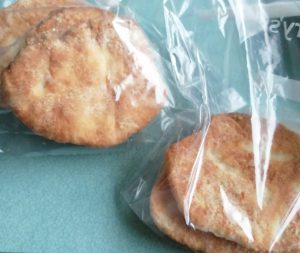
This was when Aberdeen was booming, and Union Street, its main shopping drag, had everything you could need to buy back then. Just as New York has Bloomingdale’s and Macy’s, London Harrods, and Edinburgh (until recently) Jenners, Aberdeen had an iconic department store called Esslemont and Mackintosh, or E & M’s for short. One of the rituals to be observed on a weekend visit to Grandma was coffee and butteries at E & M’s (buttery being a local delicacy: think a very compressed croissant, with an even higher butter content, and often salty).
In the afternoon, Dad and I would generally head to Pittodrie, although whether this was to escape the womenfolk or to ‘enjoy’ the dubious
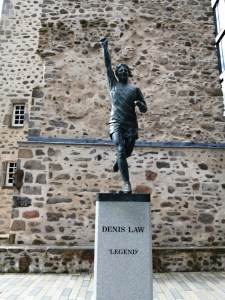
pleasures of watching the quixotic local football team as they and we shivered in a bitter North Sea gale was never fully explained to me.
So, what did we do in Aberdeen on our recent visit? Well, first off, we went for lunch and I nearly got embroiled in a dispute the restaurant owner was having with the City Council about demolishing the outside bit of his premises (glassed over, naturally enough in Aberdeen, so you got more than two days’ worth of use a year out of it). Then we found our accommodation, the Athenaeum Suites.

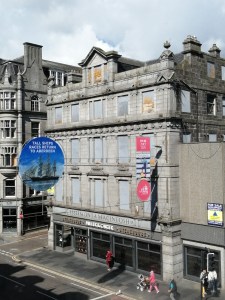
These were quite comfortable, and after an initial change of room (the first one had water coming through the ceiling) we got a good little bedroom with livingroom/kitchen suite with a view of Union Street, and a view of the aforesaid E & M’s, now fallen on hard times. Its ground floor is occupied partly by a Miller and Carter Steakhouse, and partly by another, high-end type joint which didn’t look to be at the right end of Union Street, to be honest, if there is a right end now. The upper floors are unoccupied.
We visited the Maritime Museum, which turned out to be more interesting than we’d
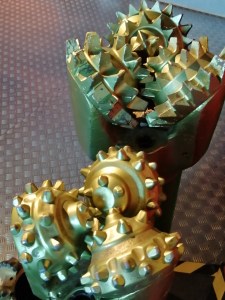
expected. It covered the early days of the fishing industry (when herring was the main catch) and then the development of the North Sea Oil industry. The city is now trying to pivot towards renewables, but it’s a tricky transition, and in the meantime, most of the guys with the ten gallon hats have gone, leaving a lot of homeless folk shivering in the doorways of Union Street.
We went on recommendations to a couple of good places to eat: for a bar supper, you could do a lot worse than the Prince of Wales in St Nicholas Lane; and 8848 for a curry (thanks to Andrew Sim and Allan Grieve respectively for the recommendations). We also went to the Gordon Highlanders Museum, out in the suburbs, as another family connection was my maternal grandfather, who had served in the Gordons in the First World War. It was a poignant visit, with a lot of space dedicated to the Gordons’ involvement in that terrible conflict, although they have of course served their country in other wars before and since with distinction.
 I’ve posted about Grandpa Anderson’s extraordinary life, and my Dad’s biography of him, before. Going round a regimental museum which, whilst not glorifying wars, at least pays tribute to the men who fought in them, isn’t something the 20-year-old me would have even countenanced. Much as I loved and admired my Grandpa, I always thought if conscription came calling for me (which, had the Falklands escalated, it might have) I’d be a conscientious objector. Nowadays, in the light of events like Putin’s invasion of Ukraine, I’m not so sure.
All of this fed into a song I had been inspired to write by reading a true story in one of the comments to a Zack Bryan album a week or so previously. Sitting in the holiday apartment the next morning, looking out at Aberdeen, the lyrics came pouring out, taking the original tale and moving it over from Kentucky to Aberdeenshire. It tells the story of a man who joins up and then finds himself involved in the various wars the UK has got itself involved in in the last quarter century. You can listen to it below, and if you order my current EP before Remembrance Day on November 11th, you’ll get the track as a bonus.
The next morning, we had some time to kill before our bus back in early afternoon. And that’s when the Very Strange Thing happened.
After breakfast in the local Costa – local indie options being thin on the ground on a Sunday morning – we went for a wander round the area. There’s Marischal College not far from that end of Union Street, a very grand affair. There’s also Provost Skene’s House, which might have been interesting enough for a visit if we hadn’t already done two museums, and needed to set time aside to hunt down a bakery that sold butteries on a Sunday.
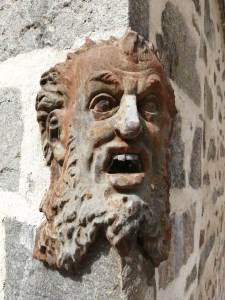
However, I was quite taken with a carving on the wall of Skene’s House, and fancied a photo of it. It was about ten feet off the ground, so to get a better shot, I stepped up onto a low wall next to it so that I’d be pretty much on the same level with my phone. As I did so, I noticed there was a coin on the wall at my feet. Given my Aberdonian (and Fife) forebears, I’m never one to pass up free money, so I picked it up.
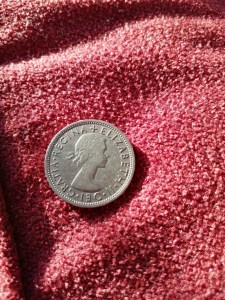 To my amazement, the coin was – see picture – a two shilling piece, or florin, dated 1966. Just to be clear, this is a coin that was last struck for circulation in 1967, pre-decimalisation of the UK’s currency in 1971. What on earth was it doing discarded on a wall in 2024? I mean, obviously these are not particularly rare coins: but why would anyone have them jingling about in their pocket in the modern day, far less lose them carelessly?
Regular readers will know that I’m pretty sceptical these days when it comes to the supernatural, and a coming blog will underline how far I’ve moved from when, as that peace-loving 20-year-old, I believed in everything up to and including the Loch Ness Monster.
Still, after a weekend of reminiscing about my childhood visits to Aberdeen, my grandmother, and indeed my parents, who both loved the city, left it only reluctantly to pursue my Dad’s career, and 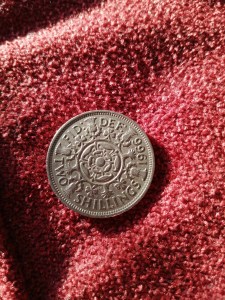 pined to return to it some day, it would take a heart far harder than my own not to feel someone, somewhere, had left that relic of the year 1966 for me to find.
The coin, by the way, now sits in the corner of the picture frame on my desk that holds my most treasured photo of my Mum and Dad, outside the newly built house in Orchard Drive, Glenrothes they moved into in 1966 or 7 – I can’t remember which. They never did make it back to Aberdeen, although when my Dad retired they named the next Fife house they moved to ‘Aboyne,’ as they always imagined retiring to that North East village as the next best thing to the Granite City itself.
If, of course, you read this post and realise you have a rational explanation for how a florin came to be sitting on a wall in central Aberdeen in September this year, I should say I’d be delighted to hear from you.
I’d be lying though.
 andrewcferguson
That is cool about the coin. When I was in Scotland recently, I came upon this apt quote from Yeats: “The world is full of magical things patiently waiting for our senses to become sharper.”
Very apt Marie! Yes, something like that does make you wonder.
For years, that coin had been patiently waiting for you to show up. Don’t spend it!
No worries there, Neil – it ceased to be legal tender a long time ago… I know I sometimes make stuff up on this blog, but I promise you, this is absolutely true. I don’t quite know what to make of it – but the florin ain’t going anywhere!
I like reading your blog pieces, Andrew – you always make them interesting. This one was pretty much a circular story, but with loads of insights into general Scottishness, which is always interesting for someone who deals with characters. I wonder how long that florin (I remember them like yesterday, though I don’t think I’ve actually seen one since I was 16) had been there on the wall. And why the person who left it there did so… Very strange. I like the wall sculpture – a bit Gothic.
Thanks! Yes, no idea what the sculpture represents – Provost Skene, perhaps, doomed to spend eternity chairing a committee meeting that never ends…
Ha ha! No wonder he has such a stern expression! Probably thinks it’s well past his lunchtime!
I’ve just had another look at him, and he does actually look pretty pissed off!
He would be – I spent 18 years in committee services, and that seemed like an eternity!
Was thinking if you have any of the books left we could use
The Huntly Loon book? I’ll ask Carole – offloaded most of mine now!