I intend to do a bit more about windows into the past in some forthcoming blogs, but meantime here’s a small pane of glass I didn’t know I was going to get to peer into.
I volunteer in the Morningside branch of British Heart Foundation on a Thursday morning. It’s rewarding in a lot of ways, not least because the other volunteers and regular staff are a friendly bunch of different ages and from differing backgrounds. Last Thursday, we were chatting in the back shop when one of my colleagues found a postcard in one of the books she was sorting. It was going in the bin, so I took it home and had a closer look.
Here’s what it looks like: 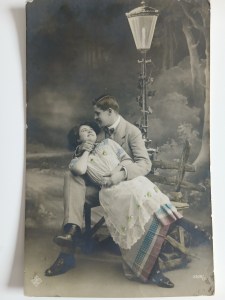
It’s from 1912, as we’ll see. It’s fairly obviously a photo posed in a studio, as these things often were in those days when iPhones were 100 years into the future. A lady sprawls – somewhat uncomfortably, it must be said – across a gentleman’s knee. All proprieties are being observed – the gentleman’s hands are where we can see them – but it seems, all the same, somewhat racy in intent. It’s black and white, but the lady’s dress has been hand coloured.
What does the other side tell us? Well, most obviously, the postcard is from Portugal. The stamps, written across with ‘Republica,’ tell a story in themselves: the Republic had been declared less than two years before, on 5th October 1910. The picture on them is of the deposed king – the new Government were keen to save a bit of cash, obviously.
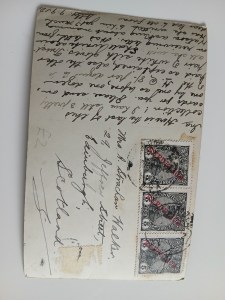 It’s addressed to a Mrs A Strachan Walker, of Jeffrey Street, Edinburgh, and from the language and content it’s been sent to her by someone who knows her well and is originally from these shores.
‘Dear Ina,’ it begins (further evidence the correspondence is between two Scots: whatever the ‘A’ stands for, ‘Ina’ is a common Scots diminutive for lots of women’s names of the period: Alexina, Williamina, etc).
It goes on: ‘Here is the last of this collection! I have still 3 pretty cards for you. Please send on, one by one as before, one dozen of the H. @ 8/- per dozen to be paid as explained, also the other pair of white silk gloves. Trust all are well. Shall write again on receiving letter. Had letter from Watson asking about mamma. Has she written to him yet? Much dear love to all from Ally. 9.9.12.’
And that’s it. You could say these postcards were the texts or tweets of the day, with limited space for a message – hence the clipped style and abbreviations like @, much used nowadays of course. So many unanswered questions, though: who was ‘Ally’? What was s/he doing in Portugal, where 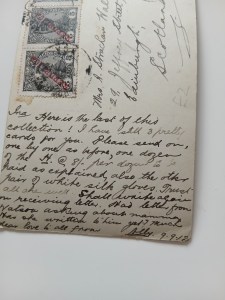 an uneasy peace had descended following the declaration of the Republic? What was the ‘H’ to be sent by the dozen, along with the other pair of white silk gloves? Who was Watson, and what was the nature of his relationship with Mamma?
It all seems so strange and so distant, and yet at the same time relatable. A functioning internet for ordinary people was 90 years away, but instead postcards of women in slightly uncomfortable poses (no sniggering at the back there) were exchanged. These days I exchange WhatsApp messages with my mate Nicky in Portugal, but I’d be lying if I said they were any more meaningful than Ally’s postcard. (And no, we don’t attach pictures of women in slightly uncomfortable poses – it’s more likely to be a snap of whatever wine we’re drinking.)

1912 is best known for the sinking of the Titanic, which happened in April. Scott and his team had been beaten to the South Pole by the Norwegians in January. Russia was still ruled by the Tsars, but a certain Vladimir Ilyich Lenin and his Bolshevik party were mobilising to become a new kind of dictatorship. In September, WC Handy published ‘Memphis Blues,’ which may or may not be the inspiration for another songwriter’s ‘Stuck Inside of Mobile with the Memphis Blues Again,’ some 54 years later. German pharmaceuticals firm Merck filed patent applications for the synthesis of MDMA, or ecstasy, in December.
Over everything, of course, there was the threat of nationalist uprisings in the Balkans against the Ottoman Empire bringing the bigger European nations into a greater conflict. I wonder how inevitable that looked to people in Portugal and Scotland, back in September 1912, two years before the First World War. In my darker moments I wonder whether we are two years or less away from the third of them.
To end on a more positive note, just around the time this postcard was arriving at Jeffrey Street, Joao Marinho Neto, currently the world’s oldest man, was being born (5th October: the post was maybe a bit more efficient in those days). So it’s a stretch to say 1912 is in living memory, but it nearly is.
So far away, and yet…
 andrewcferguson
I’m glad you rescued that postcard from the bin. I’m sure that the original writer had no idea that it would be still exist over a century later. They are fascinating little snippets of a long gone time.
Thanks! Glad it’s not just me finds this kind of thing fascinating!
A very thought-provoking essay! If there ever is another world war, it will probably be the last, as there won’t be too many survivors of it. And those who survive probably will wish they hadn’t.
Let’s just hope common sense prevails over the mad folk at the top, Neil.
Of course, were you so minded, you could investigate the address further via the 1911 census ..
Thanks Mike! I might do that!