 So, as regular readers of this blog will know, we moved from Fife to Edinburgh three years ago come the 16th of last month, and we love it here. Indeed, it has been put to me that I’m always banging on about it.
Well, that’s as may be. If so, suck it up, because we do love it here, and there’ll be more of the same. And one of the things we love is living exactly where we do: near the foot of Blackford Hill, on Edinburgh’s South Side. There’s something about this side of town that’s always clicked with me: when I was a student, I shared a flat for two years in West Newington Place with a pal I’d made in halls of residence, and I used to walk about the same streets I haunt now, just marvelling at the – well, the architecture I guess, but also the way the history never seemed to go away.
What do I mean by that? It’s like Edinburgh never outruns its past – hell, it doesn’t even  try to. Take the ghost signs you see everywhere, peeling-but-still-there reminders of what shops and other premises were used for. I’ve probably posted a picture of the one on the right before, but it’s my one of my favourites, right next to one of my favourite cafes near the Meadows. The bit of the sign down the side suggests it was a dairy, but it’s the ‘Persevere’ bit (Leith and Hibernian FC motto) that always makes me smile.
Just as I did back when I was a student, I walk everywhere when time allows, because there’s always something new, some skyline you’ve not noticed before, some ghost sign revealed as a shop gets refitted, a plaque about some famous writer or murderer or something else to catch your eye.
Just about everything we could ask for is south of the Royal Mile: shops, including one of the City’s best guitar emporiums, cafes, bars, restaurants, a 50m pool, gyms, a place to watch league-level cricket, the list goes on…
 But where does the South Side begin? I don’t know if there’s a formal definition, but on the occasions when I do visit the North Side, the 240-year-old New Town perhaps, I like to walk back and feel the South Side feeling come over me as I pass through some invisible barrier. As I do, I feel like I’m coming home.
First off, there’s George IV Bridge. A generation before, the North Bridge had opened up a way for the middle classes to escape the cramped quarters of the High Street, a much dirtier, more tightly packed version of the tourist trap that is the Royal Mile these days, to the north, and the drafty parallelogram of New Town that was emerging on the slopes beyond the newly drained Nor’ Loch. However, much less celebrated is the feat of engineering that spanned the Cowgate in the fourth George’s time, and which, along with South Bridge, let a much more organic development on that side of the then city limits take place.
Passing Greyfriars Bobby’s statue at the intersection of George IV and Candlemaker Row, one of the

original vennels and other roadways that the Bridge soared above and made nearly redundant, you see on your left across the junction the Bedlam Theatre, long ago converted from its original purpose as the insane asylum where one of our best poets died. It was at the edge of the city then, so somewhere on Forrest Road you’re passing through the old Bristo Port, one of the city’s gates in the Flodden Wall. That’s the first invisible barrier.

For those of you who don’t know, the Flodden Wall was the City’s response to the disastrous battle of that name in 1513, where James IV, one of those charismatic leaders with fatal flaws, died along with most of the Scottish nobility after a vainglorious invasion of our neighbours to the south. A stout defensive wall built to combat the anticipated English counter-invasion, it was to have unintended consequences, as it limited the space for building for the next two and a half centuries, making the Old Town ever more cramped and vertiginous. You can still see bits of it standing nearby, in Greyfriars Churchyard.
That space restriction in turn was to lead to the development of the New Town two and a half centuries later. At the very moment the Edinburgh Enlightenment was springing from the cramped conditions (and alehouses) all walks of life shared in the Old Town, the New Town began emerging so that the middle classes could get the hell out. Of course, part of that Enlightenment extended to the science of civil engineering, and another two and a half centuries on, the North Bridge’s 18th century roots are being touched up currently, a little creaky around the joints perhaps, but still standing.
See what I mean about never outrunning the past? Continuing our walk past Greyfriars Churchyard,

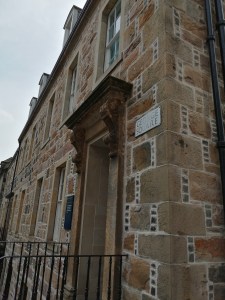
Bedlam, the Flodden Wall and Bristo Port, we cross the traffic junction at Forrest Road to get to the pedestrian/cycle route down to the Meadows, passing on our left George Square, built in the same period as the New Town, but outside the city walls to the south instead of the north.
The Meadows itself is really where you start to feel you’re on the south side. A huge lozenge of parkland crisscrossed by paths, it extends from the Tollcross/Lothian Road area in the west to the significantly named Causewayside in the east. Walk into the Meadows itself, and a timeslip of a couple of hundred years or so would mean you’d be swimming.

The site of the Boroughloch, or Burgh Loch, this was the southern counterpart of the Nor’ Loch where Princes Street Gardens and the railway line is now. The latter was mainly used for drainage and disposal, hence its historical reputation for being foul-smelling when it was drained. Its southern counterpart the Boroughloch, on the other hand, was the town’s water supply. As new supplies came on tap from Comiston further south and west, this loch, too, was drained, to create a pleasant recreational area. It took a bit longer than planned, but once it was drained, it turned into the South Side’s green lung.
In fact, it’s a tribute to Georgian civil engineering skills in the same way that the North Bridge is. A couple of months ago, heavy rains completely closed the City Bypass (construction era: 1980s) as the drainage was unable to cope. The entire city descended into gridlock. The next day, I was on a bus passing the Meadows, and not a puddle remained on it. Quite remarkable, really.
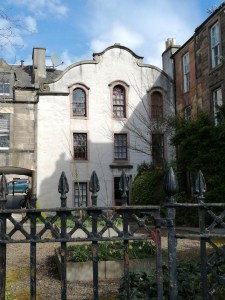
Incidentally, there are still one or two old buildings of interest around the Meadows – even when it was a loch, it had some settlement at its edges. It’s worth walking around the perimeter just for that some time. For now though, take the right fork at the start of the park proper, and you can walk or cycle across, noting on a sunny day the games of cricket, football, hockey, frisbee, etc etc happening all around you. At the other end, across the busy Melville Drive, lies the district of Marchmont.
I’ll probably write about this area separately some other time too: for now, I’ll content myself with saying it’s an early example of town planning in action (if not as early as the New Town) which sprang up between around 1880 and 1910. Before then, it was farmland, and the main roads follow the route of the old field boundaries. Oh, and one last thing: if you’ve always wondered why Marchmont Crescent and Roseneath Place run in parallel and end up at roughly the same place, it’s because the Roseneath/Argyle area was the last to be acquired and incorporated into the district, it being the only area that had previously been developed.
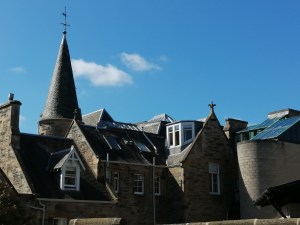
Climb the length of Marchmont Road to the intersection with Strathearn and Beaufort Roads, and you’re at the boundary with the next District, Grange. This is a very different kettle of fish, being a hotch-potch of styles and sorts of accommodation, but almost all of it hidden behind high walls and including some of the most expensive real estate in the country. Many of these are Victorian villas, which Robert Louis Stevenson was fantastically rude about in his ‘Picturesque Notes:’ ‘the dismallest structures keep springing up like mushrooms,’ he moaned, not anticipating how some of them could be made even worse by unsympathetic 20th-century extensions passed by partially sighted planners.

At the foot of the Grange you cross West Savile Terrace, drop a couple of hundred grand in property value and enter the Blackford area where we stay. But the story of Blackford’s for another day. Let’s go back to Marchmont and Newington.
A couple of months ago, I finished my morning’s work out at the Warrender Park gym in Marchmont, and headed eastward to Newington. It was late May/early June, and a succession of middle-aged men were huffing and puffing as they pushed bags and boxes into the back of family saloon cars. The university exams were over, and Dad had come to pick up Son or Daughter and take them home for the holidays (funnily enough, all the heavy lifting still seems to be a Dad thing).

Walking to Newington, to the excellent Refillery (all sorts of eco-friendly products which you can fill up on using your own containers) I took a short cut, as I often do, through the vennel from Causewayside that leads to West Newington Place. It was a quiet day, I wasn’t on any kind of deadline, and I paused outside Number 9, reflecting that it would’ve been more or less exactly forty years ago that I, along with my Dad, would have been wrestling my belongings down the stairs and out to the car as I got ready to move on from the flat share with Kenny (his parents took one look at the tip their older son and I had subsisted in for two years, and immediately started redecorating for his younger brother moving in the minute I left. Nothing but the best for Michael).
In a strange way it felt like my life had gone full circle. The years at Uni were not without
their anxieties, but by the time I stayed in Newington in my 3rd and 4th years I had pretty much worked out how much time I needed to devote to studying and how much time was left for Other Stuff. It’s fair to say the Work/Other Stuff equation was very different to what it became in the intervening decades when working full time.
Now, I still work a day or so a week, but there’s again time some days when I’m not going anywhere in particular, or nowhere particularly fast. That means there’s time, again, to enjoy where I live. I always wanted to live here again. Now I do, I never want to leave. I’m a Southsider, as if to the manor born.
You can carry me out feet first.
 andrewcferguson
loved reading this!
Thanks Maria! The blog is an occasional thing involving various subjects – appreciate you tuning in!
We recently returned from spending 6 days in Edinburgh. What a great city! You are right to be “banging on” about it. In my blog, I’m still writing about the Irish part of our trip, but I’ll be getting to the Scottish part soon.
Thanks, Marie! So glad you enjoyed your trip, and look forward to your blog soon.
It’s a superb feeling when a person knows they are living in precisely the right place. It makes life a whole, whole lot better.
Amen to that, Neil!