 So then. This blog, I like to think, is a series of messages in bottles, out there floating on the oceans, sometimes washing ashore in the most unlikely of places. Some posts I crafted over – oh, days, sometimes – have but a few moments in the sun, and then sink without trace soon after.
Then there are the floaters.
These tend to be about the more obscure things, perhaps unsurprisingly. I mean, if I put up a review of the forthcoming Bob Dylan film featuring Timothee Chalamet, it’s not exactly going to be the only one, is it?(1) On the other hand, if I post a story about long-lost all-female Glasgow band His Latest Flame, I suddenly become one of a few sources of information online. That post is solidly, consistently, one of two top things random people come to my website for. (2)
The other hardy perennial is my post on DeVille guitars. First published on 28th June, 2014, it has attracted more interest than almost any other – despite it being actually pretty uninformative. Sixteen different people have been moved to leave a comment, all, like me, seekers after the truth of who, exactly, made this obscure brand of guitar.
A typical comment on this post and the discussion threads I’ve researched for this piece will be, ‘aw yeah, I had one of these … always wondered … wish I’d never sold it … it was a copy of a [fill in famous guitar name] and I’ve played both and preferred the DeVille…’ (in the interests of balance, I should say there’s a small minority of comments on other threads that say, ‘yeah I had one, it was shit’).
Why does it matter? non guitar players might say. It’s just a guitar, after all. (3) Fair question. I’m not sure I have a great answer.
But … it just does, right? Guitarists – like other musicians, I imagine – can have an intense relationship with their instrument. It can be the source of great frustration when you can’t coax the notes out of it you hear in your head – or on Youtube, if you’re trying to emulate another player. You’d hope more often, though, that it’s your Muse, a wellspring of great pleasure, distraction and comfort, both to yourself and sometimes even others. You play it alone in the house, but also, if you’re lucky, it’s the instrument, quite literally, of some of your greatest moments on stage.
For guitarists, guitars are like lovers, and they will always matter to you. Even when you’ve traded them in for something fancier.
So, like any lover, you’re keen to know where it’s come from. Especially if it’s an obscure make. I mean, if you choose to spill for a Fender, or a Gibson, say, you can totally go on their website and fill your boots with all their guff about the wood being harvested by happily smiling tribesmen in [insert name of non-First World country with sketchy human rights record] and then hand tooled, drilled, and generally smacked upside its head into a guitar shape by aged, gnarly persons who’ve spent their entire lives wedded to the craft of luthiery in the flat lands beyond Nashville, Tennessee.
It’s the same with their better known competitors. Take Ibanez, for example: a long established guitar maker from the Nagoya region of Japan. Their site has similar reams of guff. Even Harley Benton, my budget guitar brand of choice, is very much in existence and answering my emails about how sustainable their woods are (4).
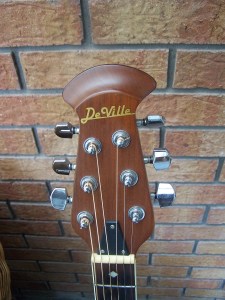
DeVille, on the other hand, is a mystery. Though its Fender Strat copy turns up in most of the online chat  about it, they also apparently made copies of Gibsons, Rickenbackers and Danelectros – as well as of Ovations, which my one was (see right). That’s quite the range – and one theory has it that, actually, it was a kind of umbrella brand name that all guitar manufacturers had for surplus product they wanted to shift under another name. I dismissed this in my first piece about these guitars, as it just didn’t seem likely that there was some kind of unspoken agreement of that kind amongst guitar makers. Besides, if there was that sort of thing going on, you could be sure someone would have handed it over to their marketing department to punt the concept as ‘buy this exclusive….!’
So, if it wasn’t that, what was it? Let’s start with the less helpful leads I followed up: guitar-list.com says simply ‘DeVille brand guitars were typically copies of the classic American solid body electric guitar designs as well as acoustics.’ At least it quotes a reputable source – me! Interestingly, it does have a link for buying DeVilles in various countries, if you’re intrigued sufficiently by this story.
Jedistar.com tells us that the logo seems to be from a 1970s headstock of a Japanese made guitar, which is perhaps our first clue to our guitars’ origins. It also links us to a forum, jag-stang.com, where a fellow Scot – and fellow seeker after the truth of DeVilles – starts a discussion which doesn’t lead us any closer to the truth, but also supports the theory that DeVilles were Japanese. Over in Malta a guy posts on guitargods.quora.com to ask for information about his DeVille, which he calls a ‘vintage Japanese guitar.’
All roads seem to point to Japan: and this is borne out by the most helpful discussion, on a Reddit forum, where someone with the handle BeefBlaster says he’s recently acquired a DeVille, which he posts loving photos of. He says they were sold in Germany (incidentally, I picked mine up in the early Nineties in Kirkcaldy, Scotland) and that, ‘according to Frank Meyers, author of The History of Japanese Guitars, DeVille guitars are a true mystery. They were made in the Nagoya area of Japan in “pop up factories” that vanished.’
If you scroll through the pictures of the guitar, you get to an image of an email from Frank Meyers, which says: ‘Hi Brian, it’s sort of funny because another fella sent me a pic of a similar guitar but with one pickup. Your guitar falls into the ‘mystery’ category because the factory couldn’t be identified. I know it came from the Nagoya area of Japan which had like 5 – 10 pop-up factories for a few years and then vanished to time. Wish I could help you more but even the old Japanese guys couldn’t recall all the factories there.’
I contacted Frank, who is indeed the author of what, so far as I know, is the definitive history of Japanese guitars (writers of rival definitive histories – please don’t write in, I’m not that interested). Unfortunately, it doesn’t seem like he’s anything to add, and I’m sure he’s busy with other stuff.
So what can we learn about the Nagoya area of Japan and its guitar factories? This blog’s Japanese correspondent (5) says: ‘I’ve been to Nagoya a couple of times. It’s a nice medium sized city. If bands do a 3 city tour of Japan it would probably be Tokyo, Osaka, and third would be Nagoya. It’s a decent place to visit. Famous food dishes are spicy chicken wings, and pork cutlets served with a miso sauce.’ Beat that, Wikipedia!
He also comments that he has an Aria Pro II guitar from the 80s, which may have been made at the Matsuoka guitar factory in Nagoya, although it seems more likely to have been the Matsumoku guitar factory in Matsumoto (following me so far?) which is in Nagano, another city in the same region but a different prefecture of the main Japanese island from Nagoya.
Where does all this take us in our quest to find the origins of DeVille guitars, other than down several Japanese rabbit holes at once? Probably nowhere much. To sum up, though, there seems to be a body of opinion that they were Japanese made, and may have originated in pop-up factories in the Nagoya region of Japan, home of spicy chicken wings and pork cutlets with miso sauce. Nagoya certainly had active luthiers during the period (roughly 70s – 90s) when the DeVilles seem to have been made, including Matsuoka, which turned out high end Aria and Ibanez branded guitars.
Ibanez itself came from the Nagoya region, and interestingly, also manufactured Fender, Gibson and Rickenbacker copies in the 1960s before lawsuits persuaded it to focus on its own designs. This might actually explain the sudden emergence, from the 1970s onwards, of ‘DeVille’ branded guitars from the same region, produced in so-called ‘pop-up’ factories, if luthiers trained to produce such copies split off from Ibanez and created their own versions, under the radar, so to speak. However, I have absolutely no evidence to back this up.
Perhaps there’s still some aged, gnarly Japanese guy left who knows the real story: maybe on that small island where they eat mostly fish and live to 150. And perhaps he has a granddaughter who, like the woman in the Yellow Pages advert, wants to help the old guy find – not Fly Fishing by JR Hartley, but evidence of his DeVille guitar pop-up factory still making waves all these decades on. And perhaps she’ll stumble on this post, and say, ‘Look, Grandpa! Some Scottish bloke has posted about your guitars…!’
If so, endearingly supportive Granddaughter, please get Grandpa to get in touch. We still love his stringed children.
Even where we have moved onto something fancier.

(1) I might. But if I don’t the world will probably keep spinning at the same speed.
(3) Other guitar players: yeah, I know.
(4) Pretty sustainable, as it turns out.
(5) Well of course this blog has a Japanese correspondent. What did you think, this was some sort of half-arsed one-man operation? Thanks to Moray Crawford for the info.
 andrewcferguson
[…] *** UPDATE: *** more info on this topic can now be found here […]
Real good article. I especially like this paragraph: “For guitarists, guitars are like lovers, and they will always matter to you. Even when you’ve traded them in for something fancier.”
Something even non guitar players can identify with, I feel, Neil!
I love this. My father bought what he thought was a Gibson knockoff or factory generic-insert “reject”- that had no name on it. He passed that to my son some years back. Now I’m all curious about this underworld of guitar-making.
There’s a whole new world to explore! The biggest ‘brand’ name I have is an Epiphone, but the truth is really quite cheap guitars can sound great in the right hands. Not that I’m saying I have the right hands….
Andrew, you hit the hammer right on the tip of the iceberg! My absolute favourite bass, and I have many, is easily a 1979 Canora neck-thru Pbass, made fretless at some point.
This brand was huge in the budget market in the 80s – maybe the biggest in Australia – now gone to the same historical vacuum as DeVille. You wouldn’t know anything about them, would you? 😏
Julian, there are only so many rabbit holes I can throw myself down… 😉
My apology – I hit the wrong button and sent a blank message. Is this typical behaviour for a DeVille owner – or perhaps it is because, somehow, I have acquired 2 of these beauties, and still have them!
The dreadnought, I bought brand new in roughly 2000. It’s had a very hard life (I’m talking kidnap, imprisonment, torture and mutilation), but I rescued it, and it’s still my go-to acoustic steel.
The other is an HH super strat, in Ibanez violet, with what looks like a Samick headstock. It plays like melted butter. I picked it up for nothing in a clearance, and have no idea of its history.
I think I need a DeVille bass….
Damn, I wish I knew more about these guitars!
Thanks for checking in, Julian. It could be typical DeVille owner behaviour – not quite sure what the rules of our tribe are yet! Interesting that your super strat is in Ibanez colours, which kind of bears out the theory that it was someone close to Ibanez that was knocking these out. Or maybe they just found a tin of paint round the back of the factory.
Anyway, love that you still have them both!
I read the above comments with interest and it led me to buy a DeVille Sunburst Stratocaster which popped up my local Facebook Market Place.
Very bad condition but with a little TLC I have brought it back from the brink and damn does it play & sound good!
David, thanks so much for dropping by, and I’m so glad my piece encouraged you to buy the DeVille! If I needed one more guitar, I think it would be something of that order (although I have a nice little HSS Ibanez that I got cheaply recently). Sadly, my wife seems to feel I don’t need one more guitar…
I can understand where you’re coming from however my wife understands the need for more guitars so I don’t have that problem.
(See attached).
Regards.
David Brown.
TTA L2 Table Tennis Coach.
ITTF-PTT L3 Para Disability Classifier.
Mobile:- 0422-511-809
David, hold onto that woman – she’s a gem!
Hi there Andrew,
This is all very fascinating and thank you for being kind enough to write about DeVille guitars and provide vital information that is pretty scant elswhere. I have had a four DeVille guitars and they have always been pretty decent and I picked up one last week from a guy in Haddington. I’m in Newhaven, Leith and have been a guitar tech on and off since the mid 1980’s.
The latest DeVille to my mind just adds to the mystery of these amazing guitars. Thie one is a really good, and I mean REALLY GOOD 335 copy. AAAA flame maple top and back, flame maple sides, maple neck with a nice headstock scarf joint.
Nicely aged cream binding, rosewood fingerboard, medium fat frets so all together nice (I bought if for myself which is rare!)
So, I have stripped to down for cleaning and identification – nothing! No labels, small pots with no dates.
I put my borescope in for look around the inside of the body fro makers marks or letters etc. Nothing.
All the wiring is definately original – no resoldering which I would spot a mile off. Here’s the odd thing – Epiphone humbuckers reading 8.86 and 8.4 ohms. Now, the only way install different pickups in this guitar is to de-solder from the pots as the wires run through drillings from the pickup cavities to the pots — and as I said, the soldering on the pots is unmolested. This leads me to believe that these were factory installed, which is intriguing.
The only other markers are a wee ‘$’ sign on the underside of the tuners which is visible when they are removed and a ‘B2’ Epiphone Tune o Matic bridge which looks original as does the stop tail. All hardware is gold.
Since doing a bit of looking arounbd the web to see if there was any other info I noticed that someone mentioned that they thought that ‘DeVille’ was a house brand for Sound Control but I cewrtainly don’t remember seeing these in the Edinburgh or Dunfermline shop, so I got onto WayBack machine and went through the Sound Control web archive and there was not a single reference to DeVille.
I’m happy to send you pics of the 335
Cheers,
Pete
Thanks again for this really useful info, Pete. The mystery deepens… would Japanese engineers have had access to Epiphone parts back in the day?
I bought my Epiphone from a guitar shop in Kirkcaldy back in the early 90s, the one that was near the Dunnikier lights if you know the town at all. I don’t think that was a branch of Sound Control. There’s local legend about the devil making ropes from sand on Kirkcaldy beach, but not guitars.
I’ll email you separately about pics, but thanks again for contributing to the worldwide sum of knowledge on this mystery!
At the moment (late December 2025) there are a few exotic DeVille’s on ebay and Reverb from the same seller. Some look like late 1980’s experimental designs, others nod to traditional designs. This seller has a vast inventory of dusty, scratched and dented guitar bodies and one-offs which presumably they get from factories in China and elsewhere.
For what its worth, two observations. First, most people who have actually owned a post-1970’s DeVille are in the UK or Europe. (So is DeVille Mk II a house-brand for a UK/European music store?) Second, the models currently on offer have very unconventional truss rod adjustments (suitable for slotted screwdrivers, not the usual Allen keys or Gibson-style wrenches). So are they relatively newly made bodies with some ancient hardware inside? Have some pop-up factories popped up in China? The mind boggles…
Carl, thanks for that useful info. Cross-referencing with somerled01’s recent comment suggests that yes, there may have been some UK/European element to the business of making these guitars in more recent decades.
Maybe after all it is just a convenient ‘brand’ for a number of guitar makers, who have popped up and then popped off! The romantic in me wants there to be some ancient Japanese guy subsisting on a diet of fish and miso soup who knows the answer to all of this though…
Sorry for two comments in the same day, but further research leads me to propose the two eras of Deville/DeVille.
A classical DeVille was on auction in Australia in 2020. The label inside the soundhole says “Made in China for Central Musical Instruments Pty Ltd Australia”.
There’s currently a beat-up Jazz bass copy on ebay in the UK with the 2nd era neck plate.
https://www.invaluable.com/auction-lot/acoustic-guitar-by-deville-6165-c-f7d450098e?srsltid=AfmBOorwqmmpe8KUxvHu2R287C3FUuUFm0WxFF5r8vFIXYVxzcF2_E-L“
No need to apologise! Thanks for coming back on this. What you suggest makes a lot of sense. I may have to do a bit more digging on this topic. It’s starting to feel like a lifelong quest…
PS beat up Strat copy with a ‘De Ville’ headstock in FB marketplace in West of Scotland – for readers local to there: https://www.facebook.com/marketplace/item/1438509597385443?ref=search&referral_code=null&referral_story_type=post&tracking=browse_serp%3A46ae930c-da40-4ab4-b4fa-18ec0f312059
Ah! Now this helps a lot.
Check out 1980’s Vester Stage Series Strats……they did the same sunburst finish on the top body contour…..why? To hide the fact that it was a plywood body – common in the 1980’s on Jap and Korean Fender copies. The much revered and ‘sought after’ Young Chang Fenix Telecasters in solid colours were plywood.
So, we are firmly in the 1980’s and early 1990’s here and lots’s of Korean and Japanese makers will still very much in the game and there is no doubt that DeVille whoever they were produced some very fine instruments, as did Vester, Fenix, Grant and Lyle.
Rock on guys,
Pete
I think I need to round up you and Carl’s comments into another blog, but I’m not sure I have the guitar maker’s chops to do it!
Hey man, that’s very interesting as I’m in the throws of decoding the ES 335 DeVille that I have here.
The three way box switch number could place it in the 1980’s, and the Epiphone humbuckers with ceramic magnets, wax potting, three wire, no screws holding the base to the bobbins and no solder holding the covers on along with ‘Epiphone’ stamped on the lower right of the baseplate leads towards 1980’s too.
Also, my guitars dimensions are exactly the same as an Epiphone ES 335 including the placement of the jack socket, controls and switch.
With a fair wind one could posit Epiphone Japan / Epiphone Korea i.e. Samick as the origin? But, the WHY of it is the puzzle to me.
My DeVille 335 definately has some age, at least the early 1990’s going by the patina and colour of the cream binding and the rosewood board which looks to be the Indian rosewood of the 1980’s.
One important stand out to me is that the one I currently have is of standout build quality throughout, and I’m a cynical guitar repair man with 40 years on the bench and I seldom buy a guitar for me. The mystery continues.
All the best,
Pete