The First World, as we Europeans so arrogantly call our north-western corner of the planet,  is in a bit of a state these days, isn’t it? Led, in the loosest possible sense, by the so-called Leader of the Free World, the President of the United States.
The US is in the New World, of course, ‘discovered’ by the Vikings and then again by Columbus. Which all came as a bit of surprise to the locals, who kind of knew about it already.
Meantime, where is Our Leader leading us? Straight to hell, boys, many of us think. Certainly into yet more intense warfare in the Middle East – does it count as the First World, since we’ve all known about it so long, and at least three of the world’s most dominant religions come from there?
I dunno. Meantime, lots of proxy wars continue in the Third World, our global catch-all for those parts of the planet that grind their way through poverty and environmental catastrophe, usually as a result of the First World’s interventions, past and present.
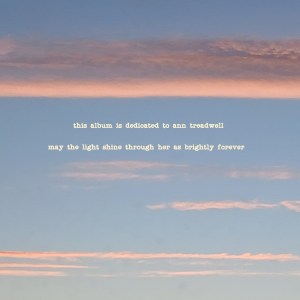
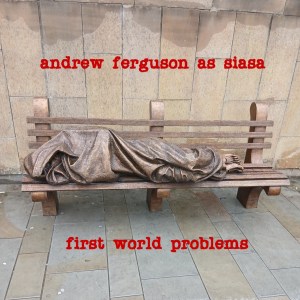 All of which is a somewhat sombre introduction to my latest album, ‘First World Problems.’ That’s a phrase that, at least in Scotland, is generally used in a self-deprecating way to emphasise that many of our so-called issues are nothing compared to what’s happening at sea elsewhere. Car wouldn’t start? First World problem. Cat been sick on your shoes? Same. Barista gave you a latte instead of a flat white? Get over yourself. And yet …
… and yet, in the West, we do have real problems, like elsewhere. People we love die, and we mourn them. Our industry is dead or dying, outsourced to China or India (which world number are they, by the way?) by the same big business interests that own the immigrant-bashing mainstream media. Incredibly, inequality is increasing in the UK, rather than decreasing. England’s rivers, streams and beaches are more polluted than they were rather than less, a direct result of public sector asset stripping carried out 30 years ago (fortunately, water and drainage remains in public ownership in Scotland, something our UK media seem to be unaware of).
There I go off on a rant again. I should really sign up to that Twitter thing for this sort of stuff. Anyway, if my album has a concept, which it kind of has if you close one eye and squint a bit, it’s sort of that.
The songs for the album took a long time to assemble for a number of reasons, but as the  soi-disant ‘concept’ took shape, I was at pains not to make it all doom and geopolitical gloom. Let’s face it, no-one wants to listen to that, do they?
I was thinking about Dylan’s classic break up album, ‘Blood on the Tracks,’ (1) not as a direct template for what I was doing, but an example of how, even when the overall record deals with hefty issues, there’s still room for some knob gags.
Okay, not actual knob gags, but if you look at the songs on ‘Blood on the Tracks,’ one minute he’s wishing his ex-wife was dead, and then he’s singing a cheery little cheerio to a woman he had an affair with (‘You’re Going To Make Me Lonesome When You Go’). The album’s got what might be the most romantic song ever written in ‘Tangled Up In Blue,’ but it’s also got ‘Lily, Rosemary and the Jack of Hearts,’ a shaggy dog story set in the Wild West.
With this in mind, although ‘First World Problems’ starts with ‘John Prine,’ about a guy whose musical buddy has up and died on him, second up is ‘Williamstown Blues,’ a daft wee ditty about fetching up in a town that just doesn’t take to you.
Incidentally, like most of the tracks, neither of these are directly autobiographical. Although I’ve attended far too many friends’ funerals in recent years, I didn’t spend my adolescence going round the pubs of Fife with a mate trying to find John Prine on the jukebox. It would’ve been one hell of a long pub crawl in 1970s Fife, let me tell you.
Nor have I spent even a single night in any place called Williamstown – of which there are several, incidentally: the States, of course; Australia; and, perhaps surprisingly, the Irish Republic. (2) It was inspired by a pal’s Facebook comment about spending one night in Williamsburg when Dylan was in town. (3)
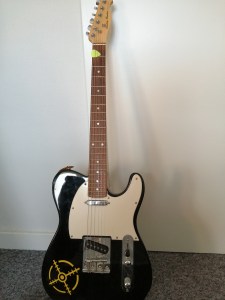 Going back to the first track, the thing I’m most pleased with is the sound of my Harley Benton Telecaster copy on it. I’m probably best known for my lyrics, but for me the fun bit is coming up with a musical backing to the words that I think works, and getting the Tele to shimmer like it does was deeply satisfying for me.
Like others the title track relies on Graham’s cajon for percussion. This was a decision we took early on, especially for the mainly acoustic tracks. Lyrically I have to hold my hands up and say the bit about the woman on the bus is autobiographical. The X55 to Dunfermline, if any of you crave that level of detail.
‘State of Me‘ nearly didn’t make it onto the album. To be honest, I didn’t know what to do with it arrangement wise, beyond the bass and guitar. I had the idea of making it into a multi-instrumental piece, like a marching band maybe, but never got around to it, and it ended up the way it was.
I don’t think I’ve ever taken so much time over track selection on an album before, by the way. At one point it was down to 10 songs, but leaving ‘State of Me’ and another track out seemed to unbalance the whole record. Sonically and lyrically, I wanted a spectrum.
‘I Believe’ is one of these rare beasts for me, a keyboard-composed song. Again I had all  sorts of ideas for instrumentation, but in the end it was stripped back to piano, with just a line of Telecaster under it. There’s a High D on a different voicing in there, but it may only be audible to certain breeds of dog. Ideas for peace bells and Buddhist monks chanting came and went.
The next song, ‘For Tomorrow,’ was conceived in February 2025. In a sense it’s one of my growing collection of Springsteen-in-a-Scottish-accent stable, and what rescued it for me was the addition of Graham’s drums, to pick up the pace of the thing. It’s not autobiographical, but I did have a very specific set of flats in mind in the line ‘they’re tearing down the old flats near where I used to live.’
In the early 1960s, East High Street, Buckhaven, Fife, was a jumble of cottages: the fishing village that Buckhyne used to be before the local landowner discovered more coal seams to exploit and turned it into a mining town.
My Dad, by then Town Clerk, had the unenviable task of sorting out the jigsaw puzzle of title deeds as the Town Council bought up the cottages, flattened them, and built blocks of flats in their place to house the miners.
Thirty years later I was the Council lawyer handling the same titles, my Dad’s signature on the warrants of registration, as the Council demolished the blocks of flats to hand over the land to a housing association. Thirty years. That’s all they lasted.
If, like me, you still think of albums as physical bits of vinyl, time to flip to side 2. The first track on the second side is ‘By the Time,’ an entirely fictional song of someone leaving a lover behind, whilst sensing things aren’t quite over.
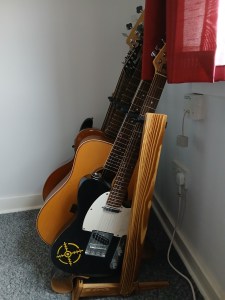 ‘Slipping Away‘ continues the theme of leaving. I’ve no idea where the song came from lyrically, and again, it might not have made the cut if it didn’t have a kind of crisp folky sound to it. Guitar, harmonica, vocal, one and done. In contrast, I had lots of plans for ‘By the Time,’ but they didn’t pan out and Graham and I agreed the call and response between the guitars worked. Electric parts of my albums are generally recorded at home, whilst acoustic instruments and vocals get done at Graham’s house on Corstorphine, where the equipment is a whole lot better. Sometimes my ideas on how a song should sound change in the time it takes the number 31 bus to get between recording studios.
‘Farewell Elizabeth‘ came quite late in the album’s formation. It’s (holding my hands up to my influences) a Dylanesque shaggy dog story. It might surprise you to know I’ve never lived on a Paris back street, nor have I ever been literally strapped to the mast of a ship. I’ve been married 38 years come August, so it’s a long old time since I was in the wrong place at the wrong time with the wrong woman, and she wasn’t called Elizabeth. However, some names have more syllables than others. Angelina’s another good one. (4)
I deliberately kept some of the heavy hitters to the end of the album. John Barlass in his 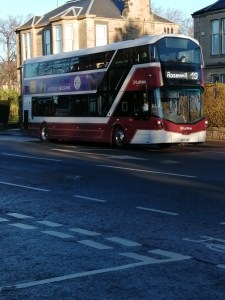 excellent review of the album picks out the next track, ‘Until We Meet Again,’ as one of the highlights, and I think he’s right. I can’t tell you what date I wrote this song, but I can say it was a Tuesday morning between 7.30 and 8.00. That’s when, most Tuesdays, I travel to my main client’s office in Leith. I sit on the top deck of the 16 to Silverknowes, observe something, and take my notebook out. I write something down – a lyrical line that’s come into my head, a song idea, both – and then put the notebook away again.
It’s a superstitious thing. If I sit with the notebook open, pen poised, nothing will happen. No, I have to put it back in the rucksack and zip it up. Then something else will occur and I have to take it out again.
Anyway, this particular day must have been early September, because they were taking down the grandstands at the Castle Gates, as the Edinburgh Festival – and the accompanying Military Tattoo at the Castle – was done. I saw this from the top deck as the 16 picked its way along Princes Street through red lights and emergency vehicles. Princes 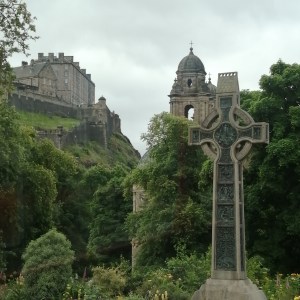 Street, originally conceived as the premier shopping street for Edinburgh’s New Town, is a sorry architectural state these days, but one advantage of it is it provides some shelter for the all-too-many homeless people that scrape by there.
I can’t swear there was a homeless girl outside a jewellery shop that day – I plead artistic licence for the syllable count again – but I have seen women sleeping rough in the doorway of Ann Summers before, which is more than a little ironic, don’t you think?
Anyway, in terms of process this one took me by surprise. Normally it’s tune first, then a trawl of the notebook for some lyrics that look a likely jumping off point. As the bus turned the corner towards Leith Walk, I thought all I had was some notes towards a song. In fact, most of the lyrics were down there, on the page, and I needed to wait for a tune to fit them.
‘Cut and Run‘ had a previous incarnation as an acoustic version, but I almost immediately started slathering more instrumentation on it: the cross-harp went on early, the electric guitars last, but what makes it of course is Graham’s drums and sax solo.
I’d always meant to finish the album with an acoustic number after the all-out assault of  ‘Cut and Run.’ Originally, that song was ‘Until We Meet Again,’ and that was going to be the title track. Then I came back from south east Asia with other ideas. I don’t think I need to say anything much about ‘A Young Mother’s Eyes‘ – it’s the most directly autobiographical on the entire album. Cambodia was both bewitching and heartbreaking.
There are a couple of bonus live tracks if you download on Bandcamp, by the way: I’ve really enjoyed playing these with Anchor Line Revue, the band I’m now in. I may say the recording, production, mastering and general wrangling of this album took one hell of a time, so it’s been a real pleasure bringing the songs to life with these guys.
So there you are. First World Problems. In the end of the day it’s an obscure album by an obscure musician from an obscure corner of the north west of the world, released on a day when about a million other albums were released. Some of those will be by far better known people than me. Most of them will be by people just like me – folk whose fan base is, more or less, their friends and family, and a few musical fellow travellers perhaps. Dreamers, all of us. But what do we dream of now?
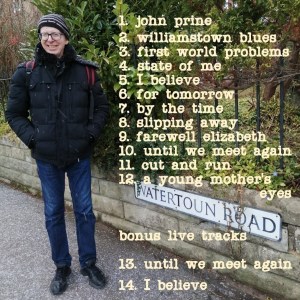 I’ve stopped dreaming of fortune and fame, for sure. I’m not completely deluded. I’m not going to be the next Bruce Dylansteen now, and, frankly, never was. What then?
Well, I don’t know about anyone else, but my remaining dream is that some words I scribbled down on the top deck of the number 16 to Silverknowes one Tuesday morning reach out and touch someone, now, or in the future, a tiny whisper in the folds of their heart that someone else felt just like they did. Something in the words, the acoustic guitar, the passion under the vocal (‘weathered’ seems to be the epithet most often used) or the moan of the lap steel, draws a spark of magic into their day.
There’s probably a reason John picks out the two most autobiographical songs as his favourites in his review, but hey, what else can a poor boy do? My life isn’t frankly that interesting to populate album after album with autobiography. Nor has it ever been.
Which is definitely, by the way, a first world problem.
(1) Dylan claims the album’s not about his divorce. But he is what you might call an unreliable narrator.
(2) For non-Brits or Irish, google ‘Battle of the Boyne’ to find out why
(3) Yes, him again. I know, I know…
(4) Actually, even that makes my past love life sound more interesting that it was. But if you’re reading these footnotes, you probably know that already.


Good work! If I were to pick my three favorite songs, they would be: By The Time; Slipping Away; Cut And Run. The whole album is strong.
Thanks for listening, Neil!